
Why Is Your Hair Thinning?
In my practice, hair thinning comes up often. Not always the opening concern, but rarely far behind. And it's no surprise... gut inflammation, nutrient depletion, and hormones are at the root of so many issues I see, and your hair is one of the first places they show up.
Whether it's more hairs on the pillow, a widening part, or strands that seem finer than before, the toll it takes on confidence is something I witness every single day. Here's what I know for certain: hair thinning is never just one thing. If biotin was the answer, trust me, you would already know."

What is actually driving hair thinning
Let's talk about what's actually happening at the follicle level. Hair thinning is driven by something called follicle miniaturization. Basically, your hair follicles are slowly shrinking. Each new strand that grows back is a little finer and shorter than the one before it, until eventually some follicles are producing barely-there, unpigmented wisps, or nothing at all.
The most talked-about culprit is DHT, a potent androgen that essentially bullies genetically sensitive follicles into shrinking. This is the driver behind androgenetic alopecia, what most people call pattern hair loss. But here's where I push back on the conventional narrative: DHT is not the whole story, and treating it like it is means missing a lot of what's actually going on.
The hair growth cycle
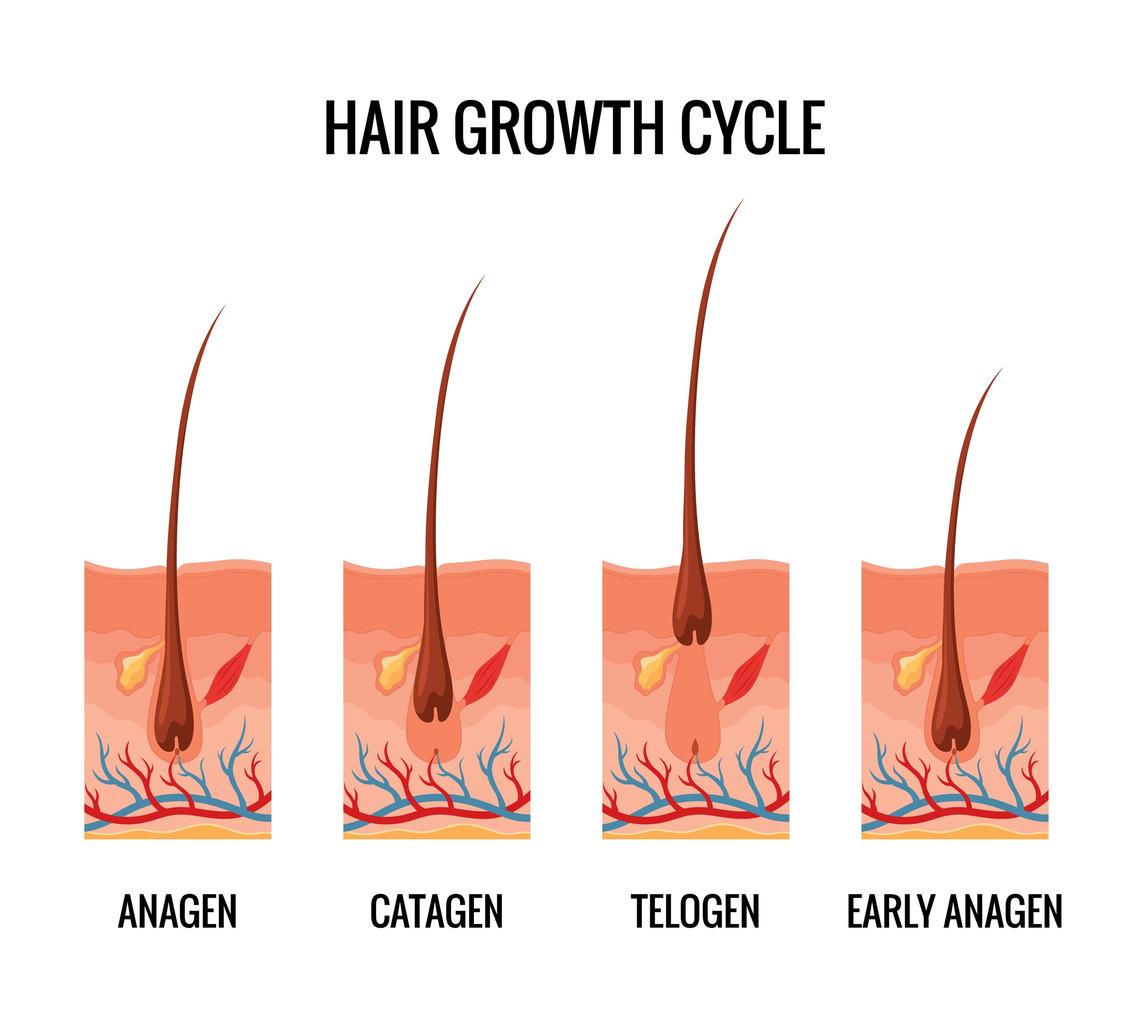
I will keep this brief because I know you did not come here for a biology lesson, but understanding this part actually matters.Each follicle cycles through three phases: anagen, the active growth phase lasting two to seven years; catagen, a brief two-week transition; and telogen, the resting phase where the hair sheds and the whole thing starts over.
The part that matters for thinning: about 85 to 90% of your scalp hairs should be in the growth phase at any given time. Anything that cuts that phase short means each strand grows for less time, reaches less of its potential, and comes back a little finer than before. Do that over enough cycles and it shows.
Hormones: let's talk about what nobody told you
I cannot tell you how many clients come to me having never had a real conversation about hormones and hair.
Let's fix that.
Estrogen is your hair's best friend. It keeps strands in the growth phase longer and supports their thickness, which is why so many women have their best hair days during pregnancy. But here's what most people don't know: progesterone starts declining first. This isn't a conversation reserved for women in perimenopause. Low progesterone shows up all the time in younger women too. Progesterone is a natural DHT blocker, so when it drops, DHT has free rein on your follicles. By the time estrogen starts declining too, you have a perfect storm that more often than not goes completely undetected or gets written off as just getting older.
Women know. They just aren't being heard.
Thyroid dysfunction is consistently underestimated as a driver of hair thinning, and it should be one of the first things you look at. Even subclinical dysfunction can disrupt the hair cycle, and here's the frustrating part: it can fly completely under the radar on standard testing. Some people simply can't convert T4, the inactive form, into T3, the active form your cells actually use. The dysfunction is there. It's just not being caught. Diffuse thinning across the scalp and loss of the outer third of your eyebrows are your clues. This is exactly why I always recommend a full panel. TSH alone will not give you the full picture.
And then there's cortisol. Chronic stress is not just bad for your nervous system, it is actively shortening your hair's growth phase. Every time your body runs on high cortisol for an extended period, your follicles get pushed out of growth and into shedding earlier than they should. Repeat that cycle enough times and the cumulative thinning becomes very real and very visible.
The nutrient piece
Hair follicles are among the most metabolically active structures in the body, and they are the first thing deprioritized when resources run low. And here is what most people don't consider: it is not just about what you are eating. It is about what you are actually absorbing. That is why gut health and nutrition have to be looked at together.
Let's start with protein. Hair is approximately 95% keratin, and when protein intake is inadequate, your body simply does not have the raw material to build a healthy strand. I see this constantly in people who are underfueling or whose digestive inflammation is getting in the way of absorption even when their diet looks fine on paper.
Then there is ferritin, the stored form of iron, which is hands down the most overlooked factor in hair thinning I see in practice. Labs mark it as normal at levels as low as 12 ng/mL, but functionally your follicles may not have what they need until ferritin is above 70 to 80 ng/mL. That gap between technically normal and actually optimal is where a lot of women are falling through the cracks.
These are the other key players worth knowing about:
Zinc - essential for cell replication and keeping inflammation in check
Vitamin D - directly involved in hair cycling, deficiency is linked to alopecia
B12 and folate - support DNA synthesis in rapidly dividing follicle cells
Vitamin C - supports iron absorption and the collagen surrounding each follicle
ON SUPPLEMENTATION Can we talk about biotin for a second? It is on every hair, skin, and nails product on the market and the evidence for it is just not there unless you are actually deficient, which most people aren't. And high-dose biotin can actually increase acne and interfere with your thyroid lab results, which is the last thing we need when we're trying to get answers. Zinc is another one: both too little and too much can cause thinning. Vitamin A toxicity is a known cause of shedding. More is not always better when it comes to hair supplements. Test first, then supplement with intention.
The gut connection: the piece most practitioners miss
Addressing the gut is not optional when it comes to hair. You can be eating a beautifully nourishing diet and still be running on empty if your gut isn't absorbing properly. Dysbiosis, intestinal permeability, or underlying conditions like celiac or IBD can silently compromise the absorption of iron, zinc, B12, and fat-soluble vitamins like D and A. I see it constantly: someone doing everything right on paper and still losing hair. There is almost always a gut story underneath it. You cannot out-eat a gut that isn't absorbing.
Where I recommend starting
If you are dealing with hair thinning and not sure where to begin, this is your starting point. Getting the right labs is one of the most important first steps, and most people have never had a complete picture run. Here is what I recommend requesting:
Complete blood count (CBC)
Comprehensive Metabolic Panel (CMP)
Iron panel with ferritin
Full thyroid panel: TSH, Free T3, and Free T4, TPO Ab, Tg Ab
Vitamin D
RBC Zinc
hs-CRP
Hormones: Testosterone (total & free), DHEA-S, estrogen, progesterone, prolactin, LH, and FSH
Comprehensive stool test
If your provider has only run a basic metabolic panel and called it a day, that is not enough. Push for the full picture.
How long does it take?
I wish I could tell you this was a quick fix. It is not, and anyone telling you otherwise is selling something.
Hair restoration is one of the slowest processes in the body, and every single person's timeline looks different depending on how long the underlying issues have been present, how well the body responds to intervention, and what we are working with hormonally and nutritionally. That said, here is a general idea of what to expect:
3 to 6 months Reduced shedding, new baby hairs at the hairline, improved texture and manageability, and strands that start to feel stronger.
6 to 12 months Noticeable improvement in strand thickness, density, and overall volume.
12 to 18 months or longer Full restoration for most people. Each follicle has to cycle through multiple rounds of growth before the change becomes visible, and you simply cannot rush that process.
What you can do is learn to track progress differently. Before it shows up in the mirror, it shows up in the details: less hair in the shower drain, a ponytail that feels thicker in your hand, new growth at the hairline, strands that actually hold a style again. Those are your wins. Celebrate them. The mirror will catch up.
THE BOTTOM LINE If your hair is thinning, please don't accept 'it's just genetics' or 'it's just aging' as a final answer. There is almost always something upstream driving it, and most of those drivers are identifiable and addressable. The work involves labs, lifestyle and dietary changes, and a lot of patience. It is not always glamorous. But it is absolutely worth doing. Your hair is telling you something. Let's figure out what.
